
By Tom Poland, A Southern Writer
TomPoland.net
When I see photographs of Colorado’s Great Sand Dunes National Park I want to explore a desert right then. Until I do, the fragile deserts along the Atlantic Ocean will do just fine. Wind, it shapes the earth, yet we never see it, just its effects, and what effects they can be.
Deep in the sands of time I memorized a poem that began “Who has seen the wind, neither I nor you: but when the leaves hang trembling, the wind is passing through.” Over the decades, which seem like eons now, I thought of those lines often. While filming a hurricane . . . flying a kite, watching winds ghost over marshes. When seeing what Helene did to the Southland. Another couplet goes “but when the trees bow down their heads, the wind is passing through.” Helen passed through with a vengeance from Hell. Wind possesses deadly power but it can be beautiful, and not in an obvious way.
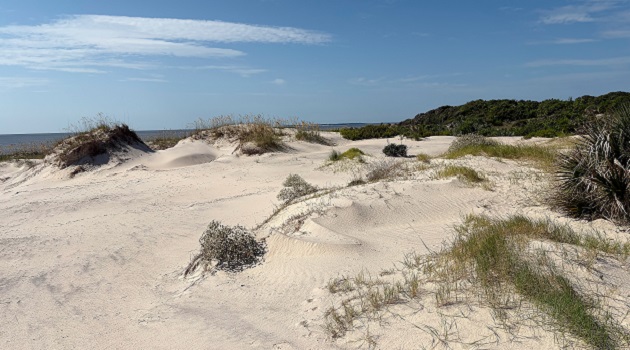
Sand dunes bless us with subtle beauty. There’s that wavering razor edge of a dune, and there’s dunes’ softer ripples betraying winds’ water-like movement. Dunes’ builder, onshore winds, gives them their shape and patterns. Thanks to the angle of repose, dunes’ apex possesses a defined edge. The side facing the wind presents a gentle, slope where wind pushes sand grains upward. The side away from the wind forms a sharp drop-off or ridge.
The angle of repose, a relaxing phrase as if napping, piles sand up to a steep angle of about 30 to 34 degrees. Additional sand grains tumble over the ridge’s backside maintaining that sharp edge. Several factors come into play. Smooth, round grains easily tumble, creating a lower angle. Rough, jagged, or interlocking grains create steeper angles. Size makes a difference too. Coarser sands form steeper dunes than fine, powdery sands do. Less moisture binds particles and increases the angle. Too much moisture can prevent any angle at all. Winds from various directions sculpt sands into what look like ripple marks in the soft sand.
I doubt I ever see a major desert but I love dunes. They’re a desert by the sea, a place where shifting sands, salt water, a brutal sun, and rain percolating through sand create desert-like environments. It takes a special plant to live in the dunes as anyone who walks barefoot over summer’s sunbaked sands knows. And what about those barefooting beachgoers? Do they notice dunes’ textures and shapes? Their sustaining vegetation?
Who has seen the wind, neither I nor you. Well, it’s easy to see wind’s passage when sea oats dance on a dune. Not so easy to see the textures resulting from wind-blown sand. That calls for an attentive eye. Intricate patterns let you see, if not the wind, its magic.
One more thing. I never walk through dune pass-throughs without looking at the plants that give dunes splashes of green and wildflower blooms and stability. Roots and rhizomes hold dunes in place, allowing the wind to build them stronger and higher.
Sand dunes are far more than mounds of sand. They’re important barriers to the sea and vital habitat to sea turtles and other species. Constantly changing their shapes and colors, they seem an alien world yet their sands teem with life.
I like sand dunes. I cannot imagine seeing breakers with no dunes anywhere in sight. Paulo Coelho in The Alchemist wrote: “The dunes are changed by the wind, but the desert never changes.” And Christina Rossetti wrote “Who Has Seen the Wind?” and now her short rhythmic poem will stay in your mind like some treasured song from the radio. And maybe the wind and dunes will too.