
By Tom Poland, A Southern Writer
TomPoland.net
Thirteen years ago I wrote of highways with memorable names. I mentioned Whiskey Road and Easy Street in Aiken as one of the country’s more photographed road signs. In Albany, Georgia, Lonesome and Hardup Roads make an interesting intersection, and in McCormick County you’ll find Redemption Way, the road to the state prison for men. I wrote, too, of Sewer Plant Road in North Carolina, a realtor’s dread I bet.
Now I turn my attention to southern towns and places with unforgettable names. Seems a common denominator in naming places are frustration and the Post Office.
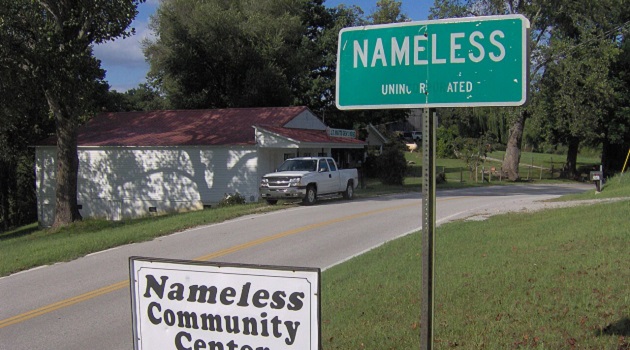
Nameless, Tennessee, is a spot in the mountains chronicled in Blue Highways, A Journey Into America by William Least Heat-Moon. The place had gone for years without a name. The U.S. Post Office told residents that if they wanted to get mail, they had to name the town proper so people could address a letter to it. Residents convened but couldn’t agree on a name. One man wanted it named after him. Some wanted a name from nature. Some wanted a patriotic name. When they ran out of names a fella tired of the talk said, “This here’s a nameless place if I ever seen one so leave it be.” And that’s how Nameless, Tennessee, came to be.
Down near Tifton, Georgia, you’ll come across Enigma. Founders had trouble deciding what to call it. Again the Post Office played a role in the name. John A. Ball was the first postmaster of the place known informally as “Gunn and Weston” for two men who built a sawmill nearby. When Ball applied for an official name, he submitted two options: “Lax” and “Enigma.” “Lax” was taken so “Enigma” won out. Said Ball, “It was a puzzle what to name it anyway.”
Harry Crews set his novel, The Gospel Singer, in Enigma. The book follows a famous traveling gospel singer who returns to his hometown of Enigma for a revival. The story involves violence, a freak-show entourage, a murder accusation, and a grim ending. Some locals were unhappy with how the town and its residents were portrayed. Crews later set another Georgia novel, A Feast of Snakes, in a fictionalized version of nearby Mystic, named for Mystic, Connecticut, the hometown of early settlers.
You’ll find Sugar Tit, South Carolina, in Spartanburg County. Sugar tit is an old Southern term for a homemade baby pacifier, a piece of cloth filled with sugar or sugarcane. The story goes that men spent so much time at the local country store their wives complained they flocked there “like babies to a sugar tit.” The name sucks you could say.
In North Carolina’s Randolph County there’s an unincorporated community named Whynot. When residents gathered to name the new post office, they suggested ideas saying, “Why not this?” and “Why not that?” After a long, fruitless meeting, a fed-up farmer said, “Let’s name it Whynot and go home.” They did.
Over in Alabama’s Elmore County there’s the community of Slapout. When customers asked for flour or sugar, the general store owner often would say he was “slap out.” The phrase became the community’s name.
One more Alabama memorable place, Scratch Ankle. Railroad workers noticed residents constantly scratched their ankles. The blame probably goes to chiggers and/or mosquitoes. They started calling the place Scratch Ankle.
Think your hometown’s name is boring? What if you lived in Embarrass, Minnesota, Ding Dong, Texas, Booger Hole, West Virginia, Intercourse, Pennsylvania, or Hell, Minnesota.
You young families . . . Having trouble coming up with a name for the baby? Get the Post Office involved. Carrier, Track, or Stamp sound ok? Maybe Zip will win the day. It could work for a boy or girl and it’d be memorable, a first-class name.