
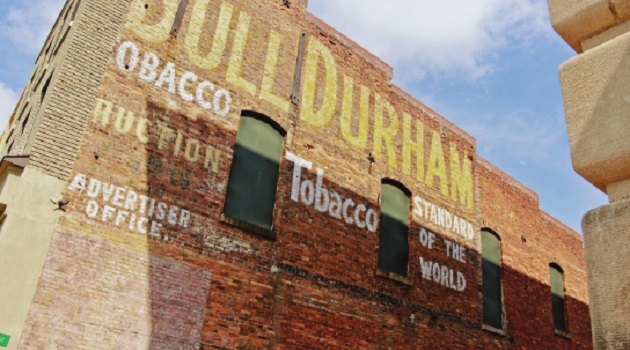
A wall dog mastered this dangerous high wall.
By Tom Poland, A Southern Writer
TomPoland.net
“Wall dogs” you say?
Wall dogs I say. They worked like dogs in all sorts of weather. Leashed to barns and brick buildings they created art. As time passed, as paint faded, their work became ghost signs. Bleached by sunlight and washed by rains, they look ghostly, an apparition.
You’ve seen ’em. Old ads painted onto a brick wall that hawk products and businesses that no longer exist, Coca Cola being an exception. Owl Cigars. Old Reliable Bruton’s Snuff. King Midas Flour. Can’t Bust ’Em Overalls, and Uneeda Biscuit.
Ghost signs went up in the late 1800s on through the Great Depression into the 1960s. Zoning and billboards led to their demise, but some cling to walls that have long given them a home. Demolitions that make way for modern structures rob us of ghost signs. When you come across one, photograph it.
What were these vintage sign painters like? They lived a rough, itinerant, proudly unconventional, independent life of danger, including falls and mixing toxic formulas of lead, linseed oil, and pigments. Crotchety, resourceful, obsessed with craft, and no fan of domestic life, they spent months on the road painting a wall a day. They slept in the back of pickups, cheap motels—whatever was available—and ate in greasy spoons.
Harley Warrick, the famous Mail Pouch Tobacco barn painter, returned from World War II with no civilian clothes. He painted in his Army uniform and combat boots. Gone for long stretches, his wife gave him an ultimatum—job or me. He chose the job. He painted freehand, deliberately misspelling words (“TOBACCCO”) to see if anyone noticed.
Wall dog Battler Smith of Chicago—crusty in appearance and salty in language—chewed tobacco and spat freely whether he was on the sidewalk or twenty stories up. Wall dogs’ work had its ups and downs as you can see. They only got to break the law of gravity once.
Someday I hope to have a Norman Rockwell-like experience driving into a one-stoplight town. I’ll watch a wall dog painting a brick wall. He’ll reach for his paint-splattered level and make a mark where the words will go. He’ll make a white “B,” a “U,” then a “L.”
Much later he lowers himself to the ground to admire his work. Then it’s time to load up and travel to the next town. In the decades to come his Bull Durham ad will crack and fade but like a weathered face, it’ll possess character and it’ll hang in there. Lead-based paint bonds strongly to brick whose mortar lines gave wall dogs a natural grid.
Wall dogs’ heyday ran from the late 1800s with the peak in the 1920s to 1940s. It was dangerous, poorly paid work. Falls were common, and lead poisoning, “painter’s colic,” was an occupational hazard.
The craft faded after World War II with the rise of neon, vinyl lettering, printed billboards, and regulations such as the 1965 Highway Beautification Act.
I could take you to a Coca Cola ghost sign on a small town wall. I could but I won’t. Someone “restored” it. It went from a genteel silver-haired lady to a garish, crimson-lipped hooker. If it ain’t broke, don’t fix it. Leave ghost signs alone.
Mr. Wall Dog, you had the skills of a draftsman, chemist, artist, and acrobat. You were a survivor who endured constant travel, low pay, and physical risk. The sides of buildings gave you a studio and the open road a home. You left us a lovely haunting. RIP.
Curious why these scruffy fellows painted walls in the first place? Owners often got a small ad for their own business or below the main ad. And now you know the rest of the story.