
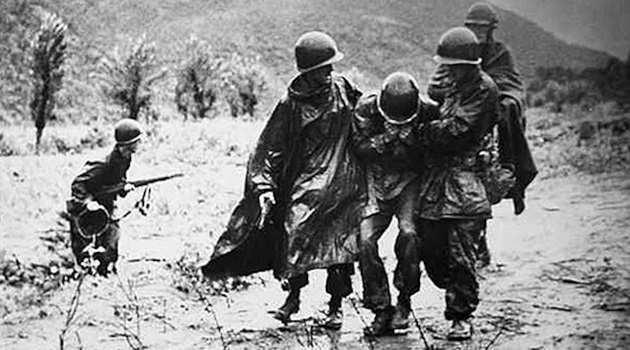
Photo: Army Chaplain (Capt.) Emil Kapaun (right) and Army Capt. Jerome A. Dolan, 1st Cavalry Division, carry an exhausted soldier off the battlefield in Korea, early in the war.
Credit:Army VIRIN:500712-O-D0439-001
By Dennis H. Klein and Wade Thompson
EXCERPT FROM
Unremembered Victory
Available on Amazon.com
In less than two weeks, the flagging of the road alignment was done and two full Combat Engineer platoons began the grading. The drilling equipment and C4 charges arrived. Blasting began and within six weeks the road was near the top. On a routine site visit, Dan could hear the sound of drilling over the din of big trucks carrying armed GIs. Shortly, the word was out. They were going to blast. Men ran and walked fast, deep into the woods, while some gathered with Daniel under a truck. The blast Sergeant yelled his loudest,
“Fire in the Hole. Fire in the Hole. Fire in the Hole.”
A HUGE explosion went off for a good 10 seconds, causing a billowy brown plume of pulverized airborne dirt, punctuated by streaking shards of jagged stone, each on its own wild trajectory. The sound of the blast blotted out all existence. Men under the truck shielded their eyes to have a limited view of the spectacle. Lots of dirt and pebbles rained down.
As the dust cleared, Daniel was flanked by Master Sergeants Kent and Rodriquez. They both had too little time left in the Army until retirement to muster out, so were considered lifers, there for the pension. However, retiring with as much rank as possible, short of going to Officer Candidate School, made them up to task, whatever it was. Once the force and fury of the blast had subsided, Sergeant Rodriguez spotted something far more furious and foreboding than the side of a mountain being blown to bits – a Huey Helicopter inbound, already close enough to see that it had two white stars inside a red rectangle on its side. It could mean only one thing. General Izenour was coming in.
Rather than get ready for the visit, the two sergeants fell to arguing over who had more rank? Who was going to have to face the general? This angst abruptly ended when it dawned on them that neither needed to face the General since LT. Schikevitz was clearly the ranking officer. He could do it alone, as the two of them ran into the woods. Dan’s next thought was, “Dang” He is already out of the helicopter and heading up the hill.” Daniel faced the general with the best full brace salute he had. The distance between them rapidly shrank to less than four feet. Long before that, Izenour was already SCREAMING at the top of his lungs,
“How long before this road will be finished.
Daniel yelled back,
“I cannot speak for the whole battalion, SIR.”
General Izenour instantly shot back,
“Cut the crap you little pipsqueak, HOW LONG.
Daniel bellowed short of spitting out a lung,
“FIVE WEEKS, SIR.”
Before the ‘SIR’ had passed Dan’s lips, General Izenour had already turned on his heels and walked most of the way back to the Huey. As the Huey lifted off, Daniel, who had been saluting for a minute or so, forlornly dropped his salute that was not going to be returned.
After the General left, the Sergeants came back out of the forest and huddled with Daniel and asked if it were possible to be finished that soon.
Daniel said, “We have two more days of blasting to bring it to grade. So, the iffy part is over but there are a lot of small jobs ahead, side hill cuts to keep the road hidden from the North. It can be done that fast. It will be a push, but push is what you guys do, and now you know the General is watching.”
Once back at HQ, Daniel reported to Captain McDowell what happened. McDowell made no comment other than insisting that Daniel tell it directly to the Colonel. Next thing Daniel knew he was standing in front of Colonel Miller in the middle of the Colonel’s billet. Everyone was smiling while Daniel told them every detail of the encounter, except not having his salute returned. Now they were all smiling real smiles, but otherwise standing there like Daniel was not quite done. With no comment coming, Daniel blurted, “So how did I do?” McDowell remained silent but Colonel Miller, fighting to repress a smile, asked, “Five weeks huh?”
Daniel nodded agreement and Colonel Miller’s body language indicated the meeting was over. He dismissed Daniel with a quiet, “You did fine.” The Colonel was not in on it, having arrived after the 6-Day War, but Captain McDowell flashed Daniel ‘the motion.’
What’s that all about? The ‘motion’ was pretending to throw sand at Dan’s feet, making him an honorary Israeli soldier. Why? When Dan arrived in unit, being Jewish, he was invisible, Asst. HQ Company Commander, doing near nothing. The Six-Day War, just 3 weeks later, changes all that. BLOWN AWAY by Israeli performance, Dan was reassigned to the Line to go wherever he had to go to see if he could make it back. All Dan got out of it was a lifetime of knowing, like Socrates [incurable combat junkie] what it’s like to face the fire for free will.
More about the power of hard orders screamed at ORDINARY Americans [passed Army IQ test, not out of prison or mental health system, and nothing more] creating universal seamless trust, top to bottom, side to side, there is no greater [military] force. Graduation day came for Dan when, North of the Fence, a noncommissioned soldier walking toward him he did not know, out of nowhere, gave him THE record braking best salute of a lifetime, screaming like his lungs could pop out, Keep up the Fire SIR. As little as a few minutes later, the same soldier might repeat this intrapersonal contest upon eye contact with another officer. Dan encountered the same outburst more times before leaving the Line, at a lost at the time, why all this drama. Years later, remembering no corruption, ever growing trust, dropping casualty rates, increasing audacity and how there were ‘just no screw-ups’, he came to understood these salutes were celebrations of the mission. Dan, as an officer, represented the 2nd Infantry Division and the excellence of what it was achieving, an unconditional Victory, at the time, no way to know it would end ALL hostility on the Peninsular, not just the DMZ. Before it was over, the word was out that ‘anything is possible in the 2nd Infantry Division but General Izenour returning a salute’.
Two weeks went by, and Daniel heard over the transom that the road was FINISHED. WHAT? Daniel was out like a flash and within an hour he was standing on top of the ridge which had been simply scraped off with a single swipe of a dozer blade. Rather than following the flagged alignment compliant with even the most rudimentary military combat engineering standards, the trucks were in plain sight, right on the top of the ridge, traveling all the way to Guard Post Gladys, some half mile away, back and forth. Daniel was livid. Not only had his authority been mocked, doing the RIGHT THING had been mocked.
Furious, Daniel stopped the first infantry soldier he saw, screaming,
“What is going on here? I heard the road was already finished and I thought, impossible, way too much grading to be finished that fast, and now I see why. NOW you have done it. No one is safe. Going back and forth like this is suicide alley.”
The infantry Private quietly, respectfully and patiently listened to Daniel’s rant and then said, “Sir, I think you better tell that to our Company Commander. He is coming this way.” The Company Commander, six-foot four football full back type, same age and rank as Dan, slowly sauntered toward Dan with a casual slouch that radiated easy authority, saying,
“I gave the order to shave off the top of the hill.”
Daniel resumed SCREAMING,
“Are you CRAZY. You are all going to die. They can shoot right at you.”
The Company Commander calmly responded,
“Shooting? Shooting? Haven’t you noticed. There’s no shooting.”
Daniel, after a pause long enough to detect whether he could hear shots right then and said,
“Hey. You’re right. There is no shooting. Come to think of it, I have not heard a shot fired all day.”
The Infantry Company Commander said,
“’You betcha,’ Red Ryder. There as a lot of shooting here before started riding the trucks back and forth. We particularly like doing it at night with the lights on. There was a lot of shooting here but not since we started daring Joe to open up. You got us to grade. We added audacity. Between us, it looks like we got Joe spooked good this time. Everybody wins. No one dies. Not even Joe, who’s got a mama just like me.”
Dan reported the situation back to Battalion and everyone had a strained crooked face trying to visualize the level of violence inflicted the first time they did ‘lights-on’, enemy’s own tracer bullets speeding their peril. Within two weeks, the whole center of the line went silent night and day. Then the East side and then the West side of the DMZ and by January ’69, The Second Korean War was over, without a single firefight since to this day. By the end, it was being said far and wide, ‘Anything is possible in the 2nd Infantry Division except General Izenour returning a solute.’
So what’s war all about? One side wants We win. You lose. The other side wants All or some win, none lose. With only one side shooting first, when Joe stopped, the 2nd Korean War stopped, ending the 1st Korean War. No longer under threat of NK subversion [infiltrators everywhere all the time], South Korea soars from sticks and mud to 1st World Power in less than 40 years, its people still adoring America for being such ‘respectful guest defender’.
Yes. Tell it from the highest mountain top. America’s Boomers WON A WAR. Glorious, unconditionally right fight, so full of positive historic consequences, no downside. Nope. No dirty laundry here. So why is it not history? Why hardly one American in 1000 even knows how to say 2nd Korean War? Way too far off the bad-Billionaire narrative of increased American shame from endless military defeats for easier control of the electorate.
No. Forget all that. The 2nd Korean War is about US ALL BEING A WHOLE LOT BETTER THAN WE ARE TOLD.
Dennis Klein is a Bay Area civil engineer and digital mapping pioneer. A University of Maryland graduate and former Combat Engineering officer on the Korea DMZ, he later earned his master’s degree at UC Berkeley and built a career in regional planning. In 2002 he launched the first online national parcel map, a foundation for his current work with UCIP Services promoting universal parcel indexing for the real estate industry.
Wade Thompson, originally from Meridian, Mississippi, is a U.S. Army veteran now residing in Irmo, South Carolina. He served in Korea from April 1967 to May 1968 with Headquarters and Headquarters Company, 1st Battalion, 9th Infantry Regiment, 2nd Infantry Division—first in the Communications Platoon and later as the Commanding Officer’s driver. His duties placed him near Guard Post Gladys on the 38th Parallel, a connection the two men rediscovered nearly fifty years later. Their renewed conversations in 2016 revealed that they had served together during the tense period now known as the Second Korean War. Thompson previously contributed to a work by author Bob Kern, and Klein later invited him to write several chapters for the book Unremembered Victory.