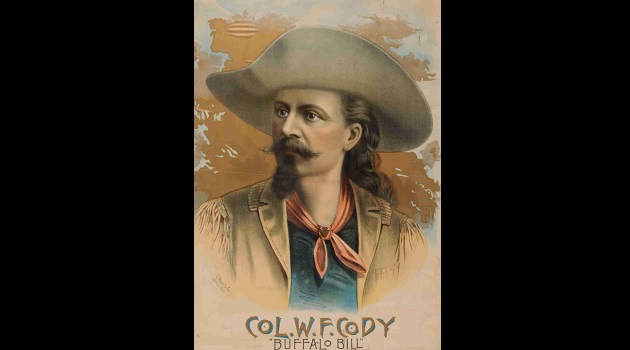
Artwork of Buffalo Bill from the Colorado Encyclopedia
By Tom Poland, A Southern Writer
TomPoland.net
I’ve drifted far from home . . . Dearly Departed they call this Denver bar. With good reason. Joseph Bona pumped embalming fluid into Buffalo Bill here. Plus, they sold caskets in this bar once upon a time. Restaurants, a legend, winter, a bar, bison, and knife make for a wild funereal tale.
After William F. “Buffalo Bill” Cody died in Denver January 10, 1917, men carried his body to Olinger Mortuary. Four days later, Cody lay in state at the Capitol rotunda. More than 25,000 people paid their respects. Then they took his body to the Elks Lodge for the funeral, but no burial. That had to wait.
Winter made Cody’s gravesite on 7,300-feet Lookout Mountain inaccessible, and no pick could dent the frozen ground. The body had to stay in the mortuary close to six months. During that time Bona would embalm Buffalo Bill six times to keep it presentable for the open-casket viewing scheduled June 3, 1917.
For some reason I see Buffalo Bill as a gunslinger — a creator of caskets. He wasn’t, but he hunted buffalo for the railroad and killed thousands with a .50-70 Springfield rifle he named Lucretia Borgia after a Renaissance noblewoman. He served as an Army scout and skirmished with Indians. In a one-on-one fight in July 1876 at Warbonnet Creek, he killed and scalped Cheyenne warrior Yellow Hair. Cody called it “the first scalp for Custer.”
In 1883 Cody launched Buffalo Bill’s Wild West, a huge outdoor pageant with scads of performers, animals, Pony Express rides, buffalo hunts, sharpshooting, riding exhibitions, and attacks on a battered Concord coach, the star prop of his Wild West show. Stars included Annie Oakley and, for one season, Sitting Bull. The show toured the United States and Europe for 30 years.
After his last Wild West performance in November 1916, an older, weaker Buffalo Bill visited Denver, caught a bad cold, then went to Glenwood Springs hoping mineral waters would do him good. They didn’t. He collapsed and was brought to his sister, “May” Cody Decker’s, house. He was baptized Catholic the day before he died of kidney failure. He was 70.
His body was taken to Olinger Mortuary—a building that now hosts restaurants in Denver’s LoHi neighborhood. “Olinger Mortuaries” became “Linger Eatuaries.” The building also houses Dearly Departed, which serves water in formaldehyde-style bottles when business is dead.
The buffalo-killing showman-to-was just eight when Charlie Dunn stabbed his father twice for making a speech in opposition to slavery. His dad died three years later of stab wound complications. Bill had to grow up fast to support his family. He became a cattle drover, did some prospecting and trapping, hunted and supposedly rode for the Pony Express. He rode in the Union cavalry during the Civil War. He got the nickname Buffalo Bill by winning a hunting contest with another man named William.
At his peak, Cody was among the most recognizable Americans on earth. Dime novels and his own marketing turned him into a legend. His shows sold that legend to millions. That was the public man. The private man drank heavily in off-seasons and gambled. Both contributed to financial problems later in life. Married but frequently unfaithful, he spent little time at home. With his long hair, moustache, goatee, and custom version of John B. Stetson’s “Boss of the Plains” hat, he’ have made a good roadie for the Allman Brothers Band. Maybe offer a few tips about life on the road. Well, it’s too late now for this rambling man.
Dearly Departed once held caskets. Conjure up Buffalo Bill in his casket beside the bar. He had a flair for the flamboyant. He will rise from the dead and buy folks a Tanglefoot, a potent whisky favorite. It will, for sure, tangle their feet as they stumble into the thin air.