
The Palmetto State’s natural heritage and cultural legacy are inseparable
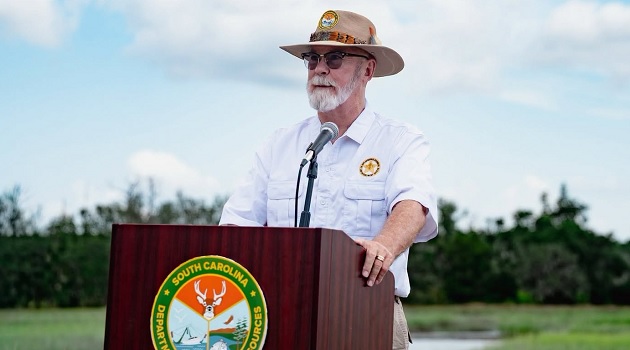
By SCDNR Director Thomas S. Mullikin
Around the world, nations strive to protect their natural resources through laws, regulations, and campaigns urging citizens to change their behavior. Those efforts matter. But history teaches us that the most enduring conservation movements are rarely born from mandates. They are born from love. The love of place, love of heritage, and love of the generations yet to come are critical.
People protect what they know, and they fight for what they love. For seven years, South Carolina has offered the world another model for conservation. SC7 has never sought to lecture. It has never demanded. Instead, it has invited people to walk together. To join us as we climb the Blue Ridge escarpment, wander through longleaf pine forests, paddle blackwater rivers, cross the rolling Sandhills, stand in the timeless quiet of the Congaree floodplain, and watch the Atlantic sunrise over beaches where loggerhead turtles have nested for thousands of years.
We have not led by proclamation but by example. More than 300 miles of trails have become far greater than a hike. It has become a journey through nearly 15,000 years of South Carolina’s story. Each step has revealed another chapter. The wisdom of the First Americans, who understood that humanity belongs to the land not the other way around. The determination of European settlers who built communities along rivers and forests. The extraordinary engineering genius of enslaved African Americans, whose mastery of water transformed the Lowcountry into one of the most sophisticated rice-producing landscapes in the world, leaving an enduring legacy that still shapes South Carolina today.
The land itself has always provided more than food or shelter. It has offered hope. Our mountains, forests, rivers, marshes, and coastlines sheltered generations through hardship, inspired artists and explorers, sustained families, and witnessed the birth of a nation.
More battles and skirmishes of the American Revolution were fought in South Carolina than in any other state. Victory here was secured not only by celebrated generals but by ordinary farmers, tradesmen, and patriots whose exceptional courage grew from an extraordinary love of home. The fields, forests, rivers, and swamps of South Carolina witnessed some of the fiercest fighting of our Revolution. The liberty secured here did more than shape a young republic. It helped ignite an idea that would inspire generations around the world that ordinary people, united by conviction and courage, could govern themselves and determine their own future. Just as these landscapes nurtured the birth of a nation, they continue to remind us that the blessings of freedom and the stewardship of the land have always walked hand in hand.
Every summer, SC7 has become a gathering place for thousands of South Carolinians including students and scientists, veterans and teachers, elected officials and business leaders, artists, families, and visitors from around the world. Together, we have walked, listened, learned, and discovered that conservation is not simply about protecting wildlife or preserving landscapes.
It is about understanding who we are. Millions beyond South Carolina have looked on with curiosity. How can a state so-often defined by its traditions also emerge as one of the nation’s most innovative voices in conservation? The answer lies not in politics. It lies in partnership. It lies in both education and leading-by-example.
Perhaps the answer is simpler than many imagine. South Carolinians have long understood that conservation is not only an environmental responsibility. It is an economically conservative one. The forests, farms, rivers, beaches, and marshes that define the Palmetto State are not luxuries; they are among our greatest economic assets. Every year, South Carolina’s tourism economy generates more than $31-billion, drawing visitors from around the world who come to experience our mountains, lakes, historic communities, and spectacular coastline. At the same time, agriculture and forestry together contribute more than $52-billion annually to our state’s economy, supporting tens-of-thousands of jobs, sustaining rural communities, and providing the raw materials that fuel industries across America. Protecting these landscapes is not a choice between conservation and commerce. It is the recognition that healthy ecosystems, productive working lands, and thriving communities are inseparable. Stewardship is not simply good environmental policy. It is a sound economic policy, wise fiscal management, and one of the greatest investments we can make in South Carolina’s future. South Carolina’s history, culture, wildlife, economy, and communities cannot be separated. They are threads woven into the same remarkable tapestry.
President Theodore Roosevelt, whose vision helped establish America’s conservation legacy, reminded us, “The nation behaves well if it treats the natural resources as assets which it must turn over to the next generation increased, and not impaired, in value.” That responsibility belongs to every generation.
That may be SC7’s greatest achievement. It has reminded us that conservation is not merely about protecting land. It is about belonging to it. Looking back, it becomes clear that SC7 was never really about hiking. The miles mattered, but they were never the destination. The trails were simply the classroom. The rivers became our teachers. The forests became cathedrals and history became our guide. South Carolina itself became the lesson.
Over seven years, SC7 helped reconnect people with the places that have always shaped them. A Revolutionary War battlefield, a Catawba homeland, a tidal rice trunk engineered by enslaved Africans, a mountain overlook, a Carolina bay, or a loggerhead turtle nest all became part of the same story. This is a story reminding us that our natural and cultural heritage are inseparable.
Long after the footprints have disappeared from the trails, that lesson will remain. It will live in every child who discovers wonder while turning over a horseshoe crab, every veteran who finds peace beneath the towering pines of the Francis Marion National Forest, every volunteer who leaves a beach cleaner than they found it, every family that spends a Saturday exploring a state park instead of a shopping mall, and every citizen who comes to understand that loving South Carolina means caring for her.
In the end, SC7 was never about walking across South Carolina. It was about helping South Carolina rediscover itself. Because the greatest journeys are never measured in miles. They are measured in hearts changed, minds opened, and lives dedicated to leaving a place better than we found it. That is the enduring legacy of SC7. And that journey has only just begun.
– Dr. Tom Mullikin, leader of the 6th annual SC7 Expedition, is the director of the S.C. Department of Natural Resources. An acclaimed global expedition leader, attorney, documentary film producer, former U.S. Army officer and retired commanding general of the S.C. State Guard, Mullikin served as the founding chair of the gubernatorially established S.C. Floodwater Commission. He has led the 1,100-plus S.C. Department of Natural Resources since early 2025.