
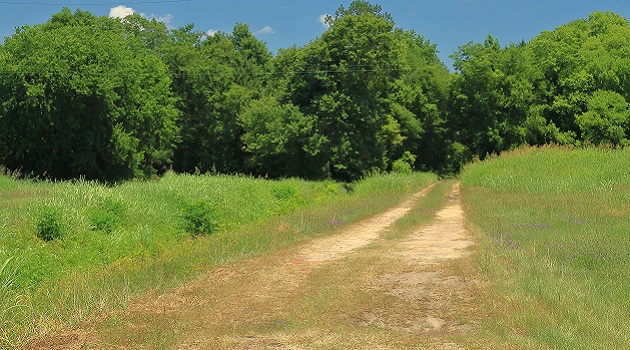
Photo: A dirt road runs where an old locomotive steamed into Blackville.
By Tom Poland, A Southern Writer
TomPoland.net
The road looks just like one on Granddad’s farm running into hardwoods where a spring bubbled in shade. Come sundown in Granddad’s battered old car, we’d ride that road through trees to pastures where white-faced cattle grazed. But where I am right now it’s bright daylight. 2:45 pm Another state even.
Had it been 1835, I would have been staring at the hardwood rails and wooden ties of the Charleston-Hamburg Railroad Line. A plume of steam might have been towering over the trees . . . the clanging bell and hissing-puff-puff-puff of a steam engine sounding as a smokestack smoked away.
I’m staring at the past in Blackville, South Carolina, where imagining an old steam locomotive brings memories of two other rail lines that suffered the disappearing railroad blues — the Wilkes-Lincoln Railroad and the Savannah Valley Railroad. What if those rail lines and others had prospered? Might we have a small-town train network today?
The Charleston & Hamburg Railroad connected Charleston to the Savannah River at Hamburg, South Carolina, near Augusta. Completed in 1833, the line stretched 136 miles, one of the world’s longest railroads at the time. The first steam-powered railroad in the United States, the first to carry mail, and the first to provide regularly scheduled passenger service is gone but you can see its railbed as you drive Highway 78.
The end of the Charleston and Hamburg Railroad occurred gradually due to an 1844 corporate merger, physical destruction during the Civil War, and track abandonment in the late 20th century.
Over in Georgia, the Washington and Lincolnton Railroad, incorporated 1914, spanned about 20 miles between Washington and Lincolnton. They built it to haul cotton, timber, and passengers between Lincolnton and the larger rail networks accessible in Washington. The Wilkes-Lincoln Railroad Company died due to 1890s’ financial depressions, agricultural setbacks, and the “Danburg detour,” a more direct path through Wilkes and Lincoln Counties, making Danburg 25 miles closer to Augusta by avoiding Washington.
Across the river, the Savannah Valley Rail turned Mount Carmel, South Carolina, into a cotton-driven railroad town whose golden years ran from 1885 to 1920. The Great Depression, boll weevil, and the growing popularity of automobiles ultimately did in the Savannah Valley Railroad. You can still see the old railbed.
Given the headaches cars create I wonder if passenger trains will someday use the interstate highways as railbeds. A little digging revealed that it’s highly likely trains will use certain corridors of the interstate highway system, but a nationwide replacement by railways is improbable. High-speed trains require straighter, flatter paths than most interstates provide.
A glimmer of hope exists. Some see highway right-of-ways, wide center medians, and shoulders as a golden ticket for rail expansion because the government already owns the land, reducing the legal nightmares of eminent domain. Well, if traffic-choked cities get worse and they will, I think “interstate rails” will get a serious look. Widening the roads sure won’t work. Decades of data prove that more lanes do not solve gridlock. They simply attract more drivers, something called “induced demand.”
Riding the rails from town to town brings back Petticoat Junction and those gals bathing in the Shady Rest Hotel water tower. Old Uncle Joe was a moving kinda slow at the Junction and so will cars that drive themselves in an era of unprecedented traffic jams. A small town network of trains sure would be nice. Just roll right long and wave at folks hopelessly mired in traffic. As you hit the countryside enjoy up-close looks at remote, untouched landscapes highways and major passenger trains simply cannot reach.