
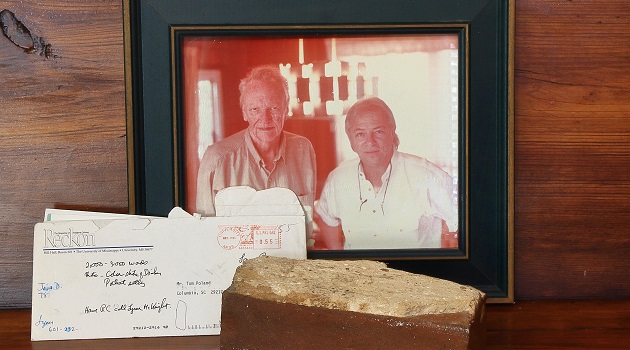
Pictured above is the author and James Dickey, June 24, 1995.
By Tom Poland, A Southern Writer
TomPoland.net
Each January, my thoughts turn to a fellow Georgian. James Dickey died January 19, 1997, of the same disease that took my mother’s life. On June 24, 1995, I interviewed Dickey for Reckon magazine, a literary journal no longer in existence. The interviewed covered Southern writing, how development was ruining the South, what’s worth writing about, and the dangers of alcohol.
Two years after the interview, one of my University of South Carolina Journalism students asked me to show her where James Dickey had lived. On a blistering summer afternoon we drove to his home. As we arrived a thunderstorm blew up. Through curtains of rain what I saw shocked me. The house had been bulldozed. We ran into the mud and fetched three bricks. Memorials, you could say, from the site where divine poetry and Deliverance were written in part.
To this day when I think of Dickey, a chain reaction takes place. Two other Southern writers come to mind. Harry Crews, a Georgian also, and Cormac McCarthy of Tennessee. All three are gone but their words live on. And how their voices sing. Below are excerpts. When I read these writers it strikes me not just because of what they write but more so how they write it. They deliver untarnished truth.
James Dickey on man’s wildness. “I go out on the side of a hill, maybe hunting deer, and sit there and see the shadow of night coming over the hill, and I can swear to you there is a part of me that is absolutely untouched by anything civilized. There’s a part of me that has never heard of a telephone.”
My take. Seems we spend so much energy on acting civilized we don’t just overlook a fundamental truth. We try to bury it. Deep within our core we’re animals.
Harry Crews on readers. “The reading public bothers me. They don’t want to read about the blood and bones and guts of an issue. They want to read about something they’re not going to have to think about, and if it does hurt them, as say Love Story does, it won’t last very long. What has happened in this country is a failure of the imagination.”
My take. The shorter a piece of writing is the more likely it will be read, and it better be light and easy . . . something about the pop culture will do nicely. Something that doesn’t tax the brain.
Cormac McCarthy on truth. “The truth is what happened. It ain’t what come out of somebody’s mouth.”
My take. A lot of people don’t want the truth if it doesn’t support their beliefs. “You can’t handle the truth.” In the 1992 movie A Few Good Men, these words came from Jack Nicholson as Colonel Nathan R. Jessup during a courtroom confrontation with Tom Cruise’s character, Lt. Daniel Kaffee. Seems to me a good many folks can’t handle the truth today. They prefer to believe what comes out of someone’s mouth.
Cormac McCarthy bears a bit more attention. I’m fond of his work because of its power, beauty, truth, and how he captures Southern vernaculars’ variations.
“If trouble comes when you least expect it then maybe the thing to do is to always expect it.”
“Do you know what happens with people who cannot govern themselves? That’s right. Others come in to govern for them.”
Tell me, do you know folks who run their mouth about the big things they’re going to do? Sure you do. Talk is cheap. McCarthy one more time.
“You think when you wake up in the mornin yesterday dont count. But yesterday is all that does count. What else is there? Your life is made out of the days it’s made out of. Nothin else. You might think you could run away and change your name and I dont know what all. Start over. And then one mornin you wake up and look at the ceilin and guess who’s layin there?”
Truth.